The book
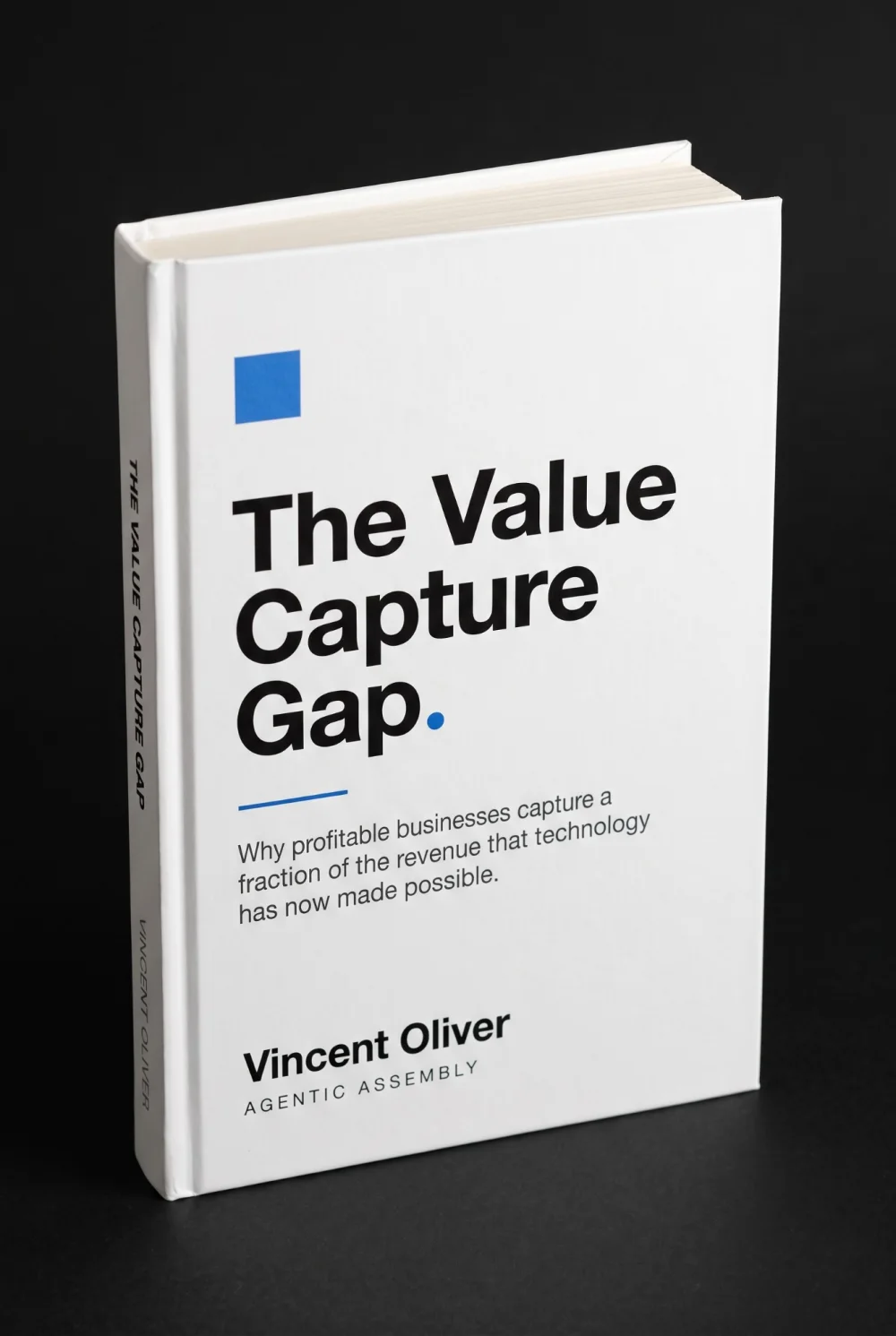
The Value Capture Gap.
Why profitable businesses capture a fraction of the revenue that technology has now made possible.
No business captures everything it creates. That was always true and it was never the problem. What changed is how much a business is now capable of creating, through technology and now through AI specifically, and therefore how much it can keep. That number is still rising, and it is rising fast.
Most companies are still operating against a ceiling that lifted years ago. The gap is not between what you create and what you capture. It is between what you could be capturing now and what you actually are.
No date yet and nothing to pay. Reserve now and you read it as it is written, a chapter at a time. That stops the day it ships.
Why this book
The ceiling moved. Most businesses never built up to it.
Business advice comes in two piles. One is about creating more: more leads, more markets, more offers. The other is about keeping more: cut costs, tighten margins, chase receivables. Neither pile addresses what actually happened, which is that technology changed how much a given business is capable of producing in the first place.
A firm that could serve forty clients can serve two hundred without hiring. A service that was too labor-heavy to sell profitably is now worth selling. Work that required a specialist requires a specification and a review. A deliverable that took a week takes a day, which means the clients you used to turn down are clients you can take.
Every one of those is revenue that did not exist for that business three years ago, and most of it is still sitting there. Not because anyone negotiated badly. Not because the receivables are slow. Because the thing that could have been built was never built.
None of this shows up on a P&L. There is no line item for revenue that became available and was never produced, which is exactly why profitable companies do not notice. The business still works. It works at a fraction of what it is now capable of, and the fraction shrinks every quarter the gap goes unexamined.
That is the gap this book is about: what your business could capture today, what it actually captures, and the specific work that closes the distance.
What it answers
The questions it is built around.
- What your business could be producing right now that it is not, and what that revenue is worth
- Which of the assets you already own are valuable, uncaptured, and one build away from producing revenue
- Which work you turned down as unprofitable is now worth taking
- Why your pricing is capped by your delivery rather than by your market
- Where technology multiplies what you can deliver, and where it only adds cost
- What it costs to find out three years late
Reserve a copy
Read it before it is finished.
Reserving does two things. The chapters come to you as they are written, which is a window that closes the day the book ships. After that it is just a book you can buy like anyone else.
You also get The Gap Report. Technology moves faster than businesses adopt it, and that distance is the gap. It is not a tool roundup. It is what a shift actually changes about how a business makes money, where it is worth moving, and where moving costs a year and a budget to find out it was not. That one keeps going after the book is done.
And reading about the gap is one thing. Seeing the size of yours is another. You go straight to the Value Capture Gap Diagnostic, which scores how much of what you already have is leveraged and how much is sitting idle, then sends back a written report.